How To Manage Foundation Cracks: A Structural Guide
How to manage foundation cracks is a fundamental skill for maintaining the structural integrity of residential and commercial properties. This process involves more than just identifying visible gaps in exterior walls or basement floors. It requires an analytical approach to understanding soil mechanics, hydrology, and the physics of load-bearing structures.
For a beginner, the sight of a fracture in a concrete wall can be alarming. However, not all cracks signify immediate danger or systemic failure. Distinguishing between a cosmetic shrinkage crack and a structural movement crack is the first step in effective asset management.
Professionals in the field recognize that managing these issues is a multi-layered discipline. It involves forensic observation, precision measurement, and the application of chemical or mechanical interventions. Modern property management now emphasizes proactive monitoring over reactive patching to avoid catastrophic financial losses.
The current landscape of property maintenance has shifted toward data-driven assessments. As climate patterns change and soil stability fluctuates, the methods for stabilizing foundations have become increasingly sophisticated. Understanding these dynamics is essential for any professional responsible for long-term building health.
How To Manage Foundation Cracks
At its core, understanding how to manage foundation cracks is comparable to managing a living organism’s skeletal health. The foundation serves as the spine of the building, distributing the massive weight of the structure into the earth below. When that distribution becomes uneven, the “spine” bends and eventually fractures.
Imagine a heavy wooden table placed on a thick, uneven carpet. If the weight is not perfectly balanced, one leg might sink deeper than the others, causing the tabletop to tilt or warp. A building foundation behaves similarly when the soil beneath it shifts, expands, or erodes.
Professionals often view these fractures as symptoms rather than the disease itself. A common misunderstanding among laypeople is that the crack is the problem. In reality, the crack is merely the visible evidence of an underlying force, such as hydrostatic pressure or soil subsidence, acting upon the structure.
Misinterpretations typically occur when a “one-size-fits-all” approach is applied to repairs. A crack caused by the natural curing process of concrete requires a completely different management strategy than one caused by lateral earth pressure. Failing to distinguish between these causes often leads to wasted resources and recurring damage.
The Structural Spine Analogy
When analyzing how to manage foundation cracks, think of the concrete as a rigid skin. This skin is designed to withstand immense compression but possesses very little tensile strength. This means it can hold weight up, but it cannot stretch easily.
External forces, such as freezing groundwater, push against this skin. If the pressure exceeds the concrete’s ability to resist, it snaps. Managing this process involves identifying where the pressure is coming from and relieving it before the snap occurs.
Professional Interpretations And Misconceptions
Structural engineers prioritize the direction and width of the gap. A vertical crack often indicates minor settling, which is frequently manageable with simple monitoring. Conversely, horizontal cracks are red flags suggesting that the wall is bowing under the weight of the surrounding earth.
Homeowners often rush to fill cracks with mortar or caulk. Professionals view this as a temporary aesthetic fix that may actually hide the progression of a more serious issue. True management involves documenting the crack’s behavior over several seasons to determine if it is active or dormant.
Deep Context And Background
The history of foundation management has evolved significantly from the era of stone-and-mortar footings. In the late 19th century, foundations were often constructed using rubble or heavy masonry units. These structures were somewhat “flexible,” allowing for minor shifts without catastrophic failure.
The shift toward poured concrete in the mid-20th century introduced a more rigid, but also more brittle, standard. This rigidity meant that any movement in the earth would manifest as a distinct fracture. The industry had to develop new ways to manage these rigid systems as they aged.
Modern standards have integrated the use of steel reinforcement, or rebar, to give concrete the tensile strength it lacks. However, many older structures lack this reinforcement. Managing cracks in unreinforced concrete requires a deep understanding of historical building techniques and the limitations of older materials.
Outdated assumptions often revolve around the idea that concrete is a static, unchanging material. In reality, concrete is porous and reactive to its environment. It expands and contracts with temperature and absorbs moisture, meaning a “fixed” foundation is actually a dynamic system in constant motion.
The Evolution Of Masonry Standards
Early builders relied on gravity and mass to keep foundations stable. As architectural designs became more complex and vertical, the load on footings increased. This necessitated the transition from simple stone footings to engineered concrete slabs and deep-pier systems.
Today, the industry uses high-strength polymers and carbon fiber to reinforce failing concrete. These modern materials are designed to bond at a molecular level, providing strength that far exceeds the original design of the wall. This shift represents a move toward restorative engineering rather than just patching.
Why Old Assumptions Persist
Many property owners still believe that a crack always means the house is “falling down.” This persistence of fear stems from a lack of transparency in the repair industry during previous decades. Today, transparency and forensic analysis are the hallmarks of professional foundation management.
Another outdated belief is that water is the only enemy. While water is a primary factor, the chemical composition of the soil—such as high sulfate content—can also degrade concrete over time. Modern professionals look at the chemistry of the site as much as the hydrology.
Conceptual Frameworks And Mental Models
To master how to manage foundation cracks, one must adopt specific mental models. The first is the “Hydrostatic Pressure Model.” This framework views the soil around the foundation as a fluid mass that pushes against the walls, especially during heavy rain.
For a layperson, this model helps visualize why gutters and downspouts are so critical. If water pools against the foundation, it creates a “heavy” soil column that exerts lateral force. Relieving this pressure is often more effective than trying to reinforce the wall against it.
The second model is the “Soil Plasticity Framework.” This considers how different soil types, like expansive clay, behave like a sponge. When wet, clay expands and pushes inward; when dry, it shrinks and leaves the foundation unsupported. Professionals use this model to predict seasonal movement.
A third framework is the “Thermal Bridge Model.” Concrete is a conductor of temperature. In cold climates, the part of the foundation above the frost line may expand at a different rate than the part below. This differential expansion can cause hairline fractures that are purely seasonal and non-structural.
The Watershed Mental Model
Think of your property as a miniature watershed. Every drop of rain that falls on the roof or the yard must be directed away from the “canyon” created by the foundation. If the watershed is broken, the foundation becomes a dam, and dams eventually leak or crack.
Professionals use this model to identify “second-order” problems. For example, a cracked sidewalk ten feet away from the house might be directing water into the foundation’s backfill zone. Fix the sidewalk, and you might stop the foundation crack from expanding.
The Decision Error Framework
This model helps professionals avoid the “sunk cost fallacy” in foundation repair. It forces the evaluator to ask: “Is this repair addressing the cause or the symptom?” If the soil is still shifting, an expensive epoxy injection is a decision error because the new movement will simply create a new crack next to the old one.
By using these frameworks, practitioners can move from guesswork to a systemic process. This ensures that interventions are timely, cost-effective, and targeted at the root of the mechanical failure.
Key Types, Approaches, And Nuances
Identifying the specific type of fracture is critical when determining how to manage foundation cracks. Each category represents a different physical stressor acting upon the concrete. Understanding these nuances prevents the application of inappropriate and expensive “solutions.”
Vertical cracks are most common in newer homes and are often the result of concrete shrinkage as it cures. These are generally managed with simple sealants to prevent water intrusion. They rarely indicate a threat to the structural safety of the building.
Horizontal cracks are much more serious. These usually occur mid-way up the wall and indicate that the wall is being pushed inward by soil pressure. This is a structural failure that requires mechanical reinforcement, such as wall anchors or carbon fiber straps.
Diagonal or stair-step cracks in brickwork or concrete blocks usually point to differential settlement. This happens when one corner of the house is sinking faster than the rest. Managing these requires stabilizing the soil or lifting the foundation back to its original position.
| Variation | Target Audience | Core Advantage | Trade-offs | Relative Complexity |
|---|---|---|---|---|
| Shrinkage Cracks | New Homeowners | Low cost to seal | Purely cosmetic fix | Low |
| Horizontal Bowing | Asset Managers | Prevents wall collapse | High material costs | High |
| Differential Settlement | Engineers | Restores level floors | Requires heavy machinery | Very High |
| Hairline Crazing | Maintenance Staff | Early warning signal | Easy to overlook | Low |
Choosing the right path depends on the “Decision Logic” of the specific site. If the crack width is less than 1/16th of an inch and shows no sign of growth over six months, a monitoring approach is best. If the crack is wide enough to insert a coin, immediate professional intervention is warranted.
Vertical And Shrinkage Fractures
These cracks usually run straight up and down or slightly diagonally. They occur because concrete is made with water; as that water evaporates, the material slightly decreases in volume. Because the concrete is pinned at the corners, it pulls apart in the middle.
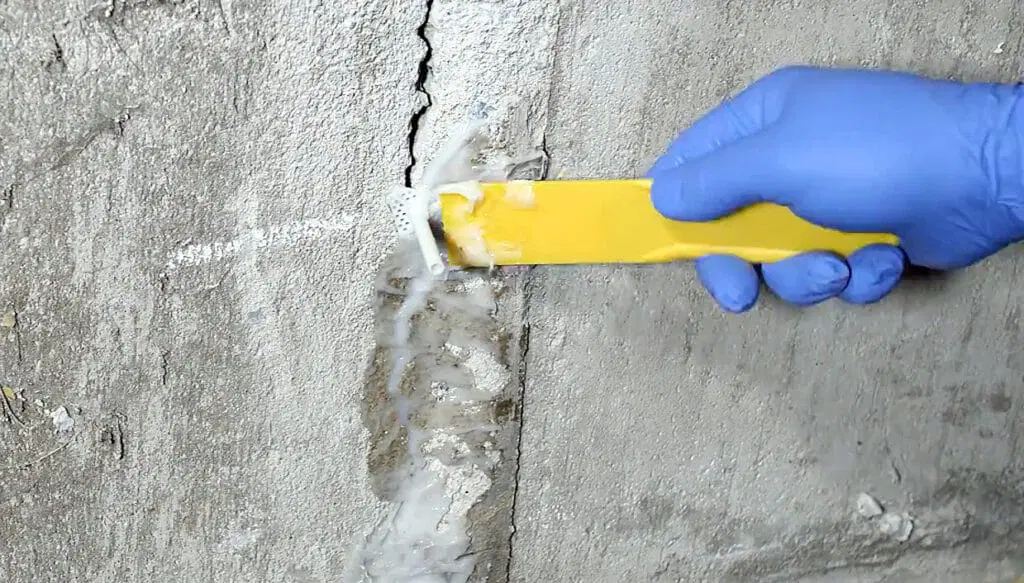
Management involves using a flexible polyurethane injection. This material fills the void and remains flexible, allowing the concrete to expand and contract with the seasons without the seal breaking. It is a waterproof solution, not a structural one.
Horizontal Pressure And Shear Stress
When a horizontal crack appears, the wall is under “shear stress.” The weight of the earth is greater than the wall’s ability to remain vertical. This is common in areas with poor drainage or heavy clay soils. If left unmanaged, the wall could eventually kick in at the bottom or lean in at the top.
The solution involves structural reinforcement. Carbon fiber straps are a modern favorite because they are incredibly thin but have a tensile strength ten times that of steel. They are bonded to the wall to provide the “stretch” that the concrete lacks.
Real-world Scenarios And Decision Trees
Scenario one involves a property located on a sloped lot. During the spring thaw, water rushes down the hill and saturates the soil against the back wall. Small vertical cracks begin to leak. The first-order decision is to seal the cracks, but the second-order consequence is that the water pressure will eventually cause new cracks.
The correct management step here is to install a French drain or a swale uphill to intercept the water. By removing the water, the “heavy” soil pressure is reduced, and the cracks may even close slightly on their own. The sealing of the cracks becomes the final, rather than the first, step.
Scenario two involves a large oak tree planted five feet from the foundation. During a summer drought, the tree roots extract every drop of moisture from the soil, causing the clay to shrink away from the footing. The corner of the house begins to drop, creating a diagonal crack.
In this case, filling the crack is useless. The decision tree leads to “underpinning.” This involves driving steel piers deep into the earth until they hit stable load-bearing strata. The house is then supported by the piers rather than the unstable, drought-stricken soil.
Scenario three features a “hairline” crack in a garage floor. The homeowner is worried, but the floor is not load-bearing. The decision logic here is “observational monitoring.” Since the garage floor does not support the house’s weight, the crack is likely a non-issue unless it begins to heave or create a tripping hazard.
Scenario four involves a basement wall with a horizontal crack that has opened up by half an inch. The decision tree here is “urgent structural intervention.” The second-order consequence of waiting is the total failure of the wall, which could lead to a partial collapse of the upper floors. This requires wall anchors that pull the wall back toward the exterior soil.
Assessing Second-order Consequences
Every decision in foundation management has a ripple effect. If you choose to underpin one corner of a house without addressing the drainage on the other side, you may inadvertently create a pivot point. This can cause the “stable” side of the house to experience new stress as the building tries to settle into its new configuration.
Practical outcomes rely on holistic thinking. A professional doesn’t just look at the crack; they look at the entire “envelope” of the building, including the roof, the gutters, the yard grading, and even the local water table levels.
Planning, Cost, And Resource Dynamics
The reality of how to manage foundation cracks involves a clear-eyed look at financial resource allocation. There is often a massive gap between the cost of early intervention and the cost of emergency restoration. Budgeting for foundation health is an exercise in risk mitigation.
Direct costs include materials like epoxy, carbon fiber, or steel piers, and the labor required to install them. Hidden costs often involve the destruction and restoration of landscaping, the removal of interior drywall to access the foundation, and the potential impact on the property’s resale value.
Opportunity cost is also a factor. Spending $10,000 on a decorative kitchen remodel while the foundation is bowing is a poor allocation of resources. The “invisible” structural repair will ultimately protect the “visible” cosmetic investment.
| Category | Entry-Level Scenario | Professional Standard | Enterprise/High-End | Key Nuance |
|---|---|---|---|---|
| Crack Injection | $500 – $1,200 | $2,000 – $5,000 | $10,000+ | Volume of cracks drives cost |
| Wall Stabilization | $3,000 – $6,000 | $10,000 – $25,000 | $50,000+ | Soil depth affects price |
| Underpinning | $1,500 per pier | $15,000 – $40,000 | $100,000+ | Number of piers is variable |
| Drainage Systems | $1,000 – $3,000 | $5,000 – $12,000 | $25,000+ | Hardscape removal adds cost |
The “cheap” fix of using hydraulic cement to patch a leaking crack often leads to expensive failures. Hydraulic cement is rigid; as the foundation continues to move, the cement will pop out or crack further, often making the original hole larger. Investing in flexible, high-grade polymers is the professional standard for a reason.
Budget-friendly Management Strategies
The most budget-friendly way to manage foundation cracks is through preventative landscape maintenance. Ensuring that the ground slopes away from the house at a rate of one inch per foot for the first six feet costs very little but can prevent thousands in repair costs.
Regularly cleaning gutters and extending downspouts ten feet away from the foundation is another low-cost, high-impact strategy. These “soft” interventions reduce the environmental stress on the concrete, allowing it to perform its job without being overwhelmed by external pressure.
Cutting Operational Waste
Operational waste occurs when property owners pay for a “structural” fix for a “cosmetic” problem. Using a crack gauge to monitor movement over six months can save a property owner from spending $20,000 on piers that the house doesn’t actually need. Data is the best tool for cost-efficiency.
Furthermore, choosing a repair method that doesn’t require massive excavation can save thousands in landscape restoration. For example, interior carbon fiber straps are often cheaper and less invasive than exterior wall anchors, provided the wall hasn’t bowed past the point of no return.
Tools, Strategies, And Ecosystems
The professional toolkit for how to manage foundation cracks has expanded beyond the sledgehammer and the trowel. Today, it is an ecosystem of high-tech sensors and advanced chemical engineering. The real problem each tool solves is the removal of uncertainty from the repair process.
Crack gauges, or “tell-tales,” are the most basic but essential tool. They are mounted across a crack and measure movement to the millimeter. This solves the problem of “visual bias,” where an owner thinks a crack is getting bigger simply because they are looking at it more often.
Laser levels and digital manometers allow professionals to map the “floor elevation” of a building. If the floor is three inches lower in one corner, it confirms that the cracks in the walls are due to settlement. This integrates the cracks into a larger structural narrative.
Injection resins, such as low-viscosity epoxies, are designed to penetrate the entire depth of a concrete wall. The “hidden limitation” here is that if the exterior of the wall is not sealed, the resin will simply flow out into the dirt. A professional must understand the “containment” of the repair environment.
Chemical And Mechanical Interventions
Polyurethane foams are used to fill voids under slabs. This “mudjacking” or “polyjacking” strategy solves the problem of unsupported concrete. The limitation is that if the soil beneath the foam is still unstable, the foam and the concrete will eventually sink together.
Helical piers are steel shafts with screw-like blades that are twisted into the ground. They solve the problem of reaching stable soil without digging massive holes. However, they require precise torque measurements to ensure they can actually hold the weight of the structure.
Integration Into A Larger System
Effective management requires these tools to work in concert. A crack gauge identifies the movement; a laser level identifies the direction; a pier system addresses the settlement; and a drainage system addresses the cause. No single tool is a “silver bullet.”
Professionals also use moisture meters to detect “invisible” water behind finished basement walls. This helps them find cracks that haven’t even manifested on the interior yet. By catching the issue early, they can apply exterior waterproofing before the interior is ruined.
Risk Landscape And Failure Modes
The risks involved in how to manage foundation cracks are not just structural; they are financial and legal. A failure to disclose a foundation crack during a real estate transaction can lead to significant litigation. A failure to repair a structural crack can lead to a total loss of property value.
Structural failure modes include “total wall shear,” where the bottom of the wall is pushed inward so far that it slides off the footing. Another failure is “differential settlement,” which can put so much stress on the house’s frame that doors won’t close, windows shatter, and gas lines can even rupture.
Operational failure modes often involve “compounding errors.” For example, a homeowner might install a beautiful new patio that accidentally blocks the drainage from the foundation. The resulting water buildup causes a crack, which the owner then patches with a rigid material that fails two years later.
The Risk Taxonomy Of Foundations
- Structural Risk: Collapse of load-bearing elements or floor joists.
- Operational Risk: Ineffective repairs that require repeat spending.
- Human Error: Misdiagnosing a horizontal crack as a simple shrinkage crack.
- Environmental Risk: Unforeseen changes in the water table or local construction.
Small errors compound into systemic failures when the “root cause” is ignored. A leaking downspout is a five-dollar fix. If ignored, it becomes a $500 crack injection fix. If that fails, it becomes a $15,000 wall stabilization project. This is the “inflationary nature” of foundation neglect.
Neutral And Practical Mitigations
The best mitigation is a “neutral observation” strategy. This involves keeping a logbook of crack measurements and photos. If you notice a crack widening only in the winter, you know the issue is related to the freeze-thaw cycle, which points toward a specific set of drainage solutions.
Another mitigation is to consult a structural engineer who does not sell repair services. This removes the “sales bias” from the diagnosis. An engineer provides a set of specifications that any contractor can follow, ensuring the repair is designed for the house, not the contractor’s profit margin.
Governance, Maintenance, And Sustainability
Mastery of how to manage foundation cracks requires moving from a static view to a “Dynamic Adaptation” model. Buildings are not permanent objects; they are slowly degrading structures that require constant upkeep to remain stable against the forces of nature.
Sustainability in foundation management means using materials and methods that will last for the remaining lifespan of the building. This involves choosing corrosion-resistant steel for piers and high-UV-resistant sealants for exterior crack fills.
Maintenance is not a one-time event but a cycle. As the earth around the house settles over decades, the grading may need to be refreshed. Trees that were small when the house was built may now have massive root systems that threaten the footing. A “static” system that isn’t inspected regularly will eventually fail.
- Annual gutter and downspout inspection (Every Spring/Fall).
- Biannual crack measurement and documentation (Every 2 years).
- Soil moisture monitoring during extreme drought periods.
- Grade verification to ensure water still flows away from the structure.
- Inspection of sump pump functionality and backup power systems.
The goal is to preserve quality over time. A well-managed foundation can last for centuries, but a neglected one can become a liability in less than a decade. Consistency in monitoring is the hallmark of a professional approach.
The Need For Dynamic Adaptation
If a new neighbor builds a large concrete driveway next to your property, the “hydrodynamic” environment of your house has changed. You must adapt. This might mean installing a new curtain drain to handle the extra runoff from their property before it reaches your foundation.
Mastering this discipline means being aware of the environment beyond your property line. Urbanization and increased “impervious surfaces” (like roads and roofs) in a neighborhood can increase the local water table, putting new stresses on old foundations.
Measurement, Kpis, And Evaluation
In the professional world, “success” in how to manage foundation cracks must be measurable. You cannot manage what you do not measure. A successful repair is one that stops the movement of the crack or the settlement of the structure within a defined tolerance.
Leading indicators are the early signals of trouble. These include doors that suddenly stick, new cracks in interior drywall, or water pooling against the exterior wall. These indicators tell you that the foundation is under stress before a major crack even appears.
Lagging indicators are the final results. These include the width of the foundation crack in millimeters or the degree of “out-of-plumb” measurement on a basement wall. By the time these indicators are significant, the damage has already occurred.
A professional proves success by providing a “post-repair elevation survey.” This document shows that the house has been lifted back to its original level and that the piers are holding under the specified hydraulic pressure. This is the objective proof of a job well done.
Leading Vs. Lagging Indicators
If you see “efflorescence”—a white, powdery substance on the concrete—it is a leading indicator. It means water is moving through the concrete, dissolving minerals, and evaporating on the surface. While there may not be a crack yet, the concrete is being weakened from within.
A lagging indicator would be a “stair-step” crack in the exterior brick. This shows that the settlement has already progressed through the foundation and is now affecting the facade. Evaluation at this stage is about “damage control” rather than “prevention.”
Documentation And Reporting Examples
A high-quality management report should include a “Crack Map” showing the location, length, and width of every fracture. It should also include “Elevation Readings” taken at various points across the floor. This provides a baseline for any future movement.
If a property manager can show a prospective buyer five years of stable crack measurements, it builds confidence. Without that data, a buyer only sees a “cracked foundation” and assumes the worst. Data is a powerful tool for maintaining property value.
Common Misconceptions And Myths
The world of foundation repair is filled with myths that often lead to poor decision-making. One of the most persistent is that “concrete always cracks, so it doesn’t matter.” While concrete does often develop shrinkage cracks, dismissing every crack as “normal” is a dangerous gamble.
Another myth is that “painting over a crack will seal it.” Standard masonry paint is not a structural or waterproofing material. It will hide the crack from view while allowing water to continue its destructive path behind the paint film, often leading to hidden mold or rot.
Many believe that “hydraulic cement is the best fix for leaks.” Hydraulic cement expands as it sets, which is great for stopping an active leak temporarily. However, because it is rigid, it cannot handle the natural movement of the house and will eventually fail, often making the crack wider.
The idea that “foundation repair always costs $50,000” is another misconception. Many issues can be managed for less than $2,000 if they are caught early and addressed with the right technical approach. Fear of the cost often prevents the early action that would have kept the cost low.
The Truth Filter
- Myth: Cracks are only a problem if they leak water. Reality: Many structural cracks stay dry but indicate a risk of wall collapse.
- Myth: You should wait until a crack stops moving to fix it. Reality: An active crack is exactly what needs intervention to prevent further damage.
- Myth: Foundation repair is a DIY weekend project. Reality: While small cosmetic fills are DIY-friendly, structural stabilization requires specialized engineering.
- Myth: All foundation companies are the same. Reality: Some focus on “sales-heavy” solutions like piers, while others specialize in “cause-heavy” solutions like drainage.
- Myth: A crack in the basement doesn’t affect the roof. Reality: A sinking foundation can twist the entire frame of a house, causing roof leaks.
Understanding *why* these myths persist is easy: they offer simple, cheap answers to complex problems. True management requires accepting the complexity and addressing it with scientific rigor rather than “hope-based” patching.
Ethical, Contextual, And Practical Limits
There are clear boundaries to how to manage foundation cracks. The first is the limit of professional expertise. A general contractor is not a structural engineer. While a contractor can execute a repair, they should rarely be the ones to *design* a structural repair without engineering oversight.
Ethical limits involve the “temporary fix” for the purpose of a sale. Masking a structural horizontal crack with a new layer of stucco without disclosing the issue is unethical and often illegal. Real mastery involves transparency and long-term thinking.
Practical limits are often set by the geography. In areas with deep “expansive clay,” a foundation may never be perfectly still. In these contexts, the goal is not to “stop” the movement entirely, but to ensure the movement remains within “elastic limits” that the building can handle.
The Gray Areas Of Repair
Sometimes, the “perfect” fix is more expensive than the house is worth. In these cases, asset managers must decide on a “stabilization” vs. “restoration” approach. Stabilization keeps the house safe but might not return the floors to a perfectly level state. This is a practical compromise.
Another gray area is the use of “heaving” vs. “settling.” If a house is lifting because of wet clay (heaving), adding piers will not help and may actually make the problem worse. Knowing when *not* to use a certain approach is as important as knowing when to use it.
Constraints Of The Modern Era
Modern building codes are stricter than those of fifty years ago. When managing an old foundation, you may find that a “simple” repair triggers a requirement to bring the entire structure up to modern seismic or energy codes. These regulatory boundaries must be factored into any management plan.
Furthermore, the environmental impact of certain resins and chemicals is under increasing scrutiny. Choosing “green” or low-VOC injection materials is becoming a standard part of responsible property management in many jurisdictions.
Conclusion: Logic Synthesis
Synthesizing the vast data on how to manage foundation cracks leads to one inescapable conclusion: structural integrity is a byproduct of moisture management and soil stability. The crack itself is merely a messenger, a physical signal that the balance between the building and its environment has been disrupted.
Effective management requires a balance between “Judgment” and “Systemic Process.” Judgment allows a professional to see the subtle signs of trouble, while process ensures that the repair is based on measurable data rather than intuition. This dual approach minimizes risk and maximizes the lifespan of the asset.
The journey from noticing a fracture to implementing a permanent solution is not a linear path but a feedback loop. Every intervention must be monitored, every drainage improvement verified, and every structural anchor tested. This ensures that the foundation remains a reliable base for the life within the building.
Ultimately, the health of a foundation depends on the owner’s willingness to look beneath the surface and address the invisible forces of nature with technical precision. Structural mastery is not about fighting the earth, but about creating a stable relationship with it through engineering and foresight.
Frequently Asked Questions
Is Every Exterior Foundation Crack A Sign Of Structural Failure?
No. Most vertical hairline cracks are the result of concrete shrinkage during the drying process. These are typically cosmetic and only require sealing to prevent water intrusion. Structural failure is usually indicated by horizontal cracks, wide gaps, or stair-step patterns in masonry.
Can I Fix A Foundation Crack From The Outside Myself?
Minor cosmetic cracks can be filled with high-quality masonry sealants by a homeowner. However, if the crack is wider than a quarter-inch, horizontal, or leaking water, it requires professional diagnosis. Attempting to DIY a structural repair can lead to further damage and may void your home insurance.
How Much Does It Cost To Fix A Typical Foundation Crack?
The cost varies wildly based on the severity. A simple epoxy or polyurethane injection for a single vertical crack typically costs between $500 and $1,200. Structural repairs, such as installing piers or wall anchors, can range from $5,000 to $30,000 or more depending on the scope of the movement.
Does Home Insurance Cover Foundation Crack Repairs?
In most cases, standard home insurance does not cover foundation repairs caused by settling, earth movement, or hydrostatic pressure. Coverage is usually only available if the damage was caused by a “covered peril,” such as a sudden pipe burst. It is essential to review your specific policy for exclusions.
How Long Do Foundation Crack Repairs Usually Last?
Structural repairs like helical piers or carbon fiber straps are designed to last for the life of the structure, often coming with 25-year to lifetime warranties. Chemical injections are also very durable but may require re-inspection after 10–15 years if the house continues to experience significant seasonal movement.